Kotter’s Change Model: Complete 8-Step Process with Case Study


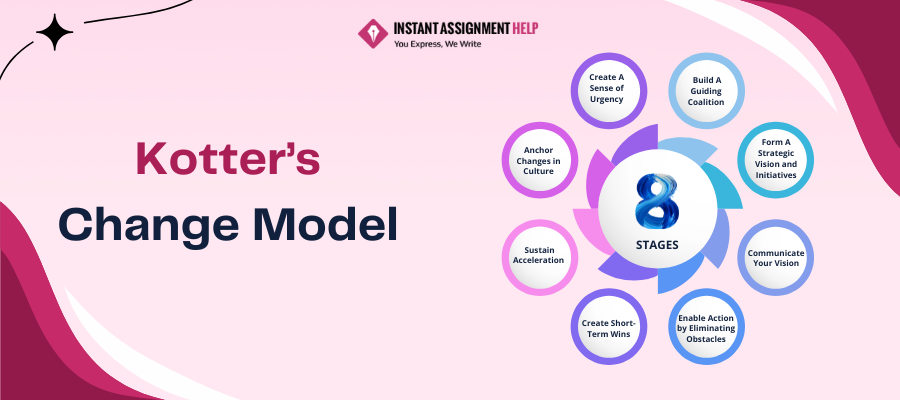
Table of Content
Change is the only constant. Everyone is aware of this phrase. But do you know that applying changes is not really easy, especially in large-scale organisations. That's when Kotter's change model comes into play. This 8-step framework is an ideal approach that organisations use to transform their existing business processes, services or internal structure. This model is designed after identifying the common issues behind the failure of change management within an organisation. Hence, it is one of the popular frameworks that many organisations use to apply changes.
This guide explains the model in detail with the Kotter model case study, benefits and limitations. In addition, it includes a comparison of Kotter's model with Lewin's change management theory.
What is Kotter's Change Model?
Kotter's Change Model was introduced by John Kotter in his Harvard Business Review article in 1995. He analysed 100 companies before inventing this change management concept. Kotter found that companies fail to apply changes effectively due to poor planning and leadership skills. Hence, he created this model, which includes 8 key steps that aim to bridge the common gaps. These challenges usually include unclear vision, avoiding employee inclusion and neglecting short-term wins.
Kotter's change management theory was built on eight key factors, including creating urgency, building a managerial coalition, creating a vision, communicating it to employees, removing hurdles, developing short-term wins, combining gains and anchoring modifications in culture. Organisation needs to follow this process step-by-step to reduce resistance and foster employee involvement. This model is highly relevant to the current business environment, which demands rapid changes.
Kotter's 8 Steps of Change
Now you must be wondering what Kotter's 8 steps of change are and how to apply them in an organisation. Thus, the information below explains each step in detail with its application within a firm. Understanding such frameworks is often essential for academic success, and many students seek assignment help UK to better grasp these concepts in practical contexts.
1. Create A Sense of Urgency
The first step requires a manager to help their teammates understand the necessity of changes. For this, it is crucial to identify crucial risks and opportunities that need immediate action. This process creates a sense of inclusion among employees, and they try to support the proposed modifications.
However, in this initial phase of John Kotter change model, the practitioner requires to clearly mention why the existing policies are no longer feasible.
2. Build A Guiding Coalition
This is the second step of the model where the practitioner needs to create an impactful team for organisational transformation. This team should consist of employees from different levels of your organisation, including employees and leaders. The purpose behind creating such a team is to ensure that they have enough expertise, influence and credibility to make changes in existing policies.
3. Form A Strategic Vision and Initiatives
Practitioner at this phase of Kotter leadership model is required to create an influential vision that shows what the organisation will achieve after applying the changes. It is vital to create an achievable and specific goal. For instance, within 3 months, our company will sell 50% of the products to increase the annual turnover. It clearly shows what they want to attain and in how much time.
4. Communicate Your Vision
After creating the vision, it is important to communicate it with all team members. Many practitioners use storytelling to convey their vision to make it highly relatable. Instead of just completing your part, you should encourage questions, suggestions and feedback. It leads to excitement in employees about the new alterations, and they become curious to contribute to the new policies.
5. Enable Action by Eliminating Obstacles
Creating new plans is not enough, as the application of these strategies requires the identification of potential obstacles that can hinder the process. These barriers could be limited resources, outdated software or even employees' resistance. Hence, according to this step of organisational change management, practitioners should work to eliminate these obstacles and empower their team.
Moreover, managers should interact with each individual to make them feel safe about the changes and risks before implementing new working methods.
6. Create Short-Term Wins
According to this stage of the change leadership model, the manager needs to plan for short-term victories by appreciating employees. These smart tricks help in creating momentum and lead to motivation. While working on this stage, it is vital to recognise and appreciate those people who were actively involved in the victory. Additionally, it builds confidence in individuals and indicates the positive impact of changes, which leads to continued efforts.
7. Sustain Acceleration
It is one of the crucial Kotter change management steps that was introduced by John Kotter to keep the teams motivated and pushing forward after realising the short wins. Hence, it includes analysing the changes and addressing remaining barriers, which may affect the entire process of change management. It usually emphasises current improvements and tries to ensure that the process functions with similar momentum without losing its speed.
8. Anchor Changes in Culture
The last step of Kotter's change management theory ensures that new processes are systematically implemented in the business culture. Therefore, at this stage, practitioners need to reinforce the changed policies by connecting them to the success of the organisation and making them a permanent part of business operations. However, managers must constantly explain the potential benefits of these changes to ensure employees feel motivated.
The Kotter leadership framework explained in detail, along with each step, to help you understand how it can be incorporated within the business optimisation process. Now, let's see a real-world case study of this model.
Case Study: Application of Change Management Model
The change model is applied by many organisations to enhance their productivity and boost their profits. Here is a real-world case study that reflects a perfect Kotter model example and its efficiency in change management.
Case Study - Ford Motor Company was facing the risk of bankruptcy under the leadership of Alan Mulally in 2006. The manager identified those probabilities and established urgency by creating a “One Ford” goal using the Kotter model for organisational change. However, for this, the organisation followed each step of Kotter's Model, which is as follows:
- Establish Urgency Situation - Alan started the process by highlighting their financial situation and potential risks, which needed immediate action. Clear communication reduced the issue of employee resistance to changeand communication barriers.
- Created Coalition - After that, he created a team by including executives of different levels who were experts in their respective fields.
- Develop a Strategic Vision -The new team worked on creating a “One Ford” vision for the organisation, which emphasised restructuring the product portfolio, global partnership and a unified brand.
- Interact Vision - Alan communicated the new vision to all employees using charts that are colour-coded with red/green colours during weekly meetings.
- Empower Other Employees - He interacted these issues to their employees and asked them to provide feedback openly without any hesitation. It fostered a collaborative approach for solving problems and increased employees' engagement.
- Create Short-term Wins - Gradually, the company launched its first Ford Fiesta in the United States, which acted as evidence of success.
- Consolidate Achievements - The company applied a similar process to streamline its international product platform to attain profit on a large scale.
- Anchor New Methods in Culture - Its new vision of “One Ford” started becoming a crucial part of the organisation, and every employee started working to achieve this vision. As a result, the organisation successfully tackled the situation and sustained profitability. It is a perfect Kotter 8 step model example that shows positive results.
Benefits and Limitations of Kotter's Change Model
The change management theory is effective for large-scale processes, but it requires time and continuous effort. Just like any other model, it has two sides, negative and positive. Here are the Kotter model advantages and disadvantages that show where and when this model can work the best.
|
Benefits of Kotter Change Model |
Kotter's Change Theory Limitations |
|
The primary aid of this model is its simple and clear structure that simplifies critical changes into actionable stages, allowing inclusion and quick transformations. |
Kotter's model of change management is strictly rigid. So, it requires practitioners to follow each step. Skipping any stage can lead to failure, making it non-beneficial for agile changes. |
|
It helps in maintaining motivation by focusing on the creation of urgency and appreciating quick victories. |
The process is lengthy, and completing each step can take a lot of time. As a result, many organisations prefer other change management theories. |
|
This change management theory works effectively for large modifications, such as acquisitions, restructuring or mergers. As a result, it focuses beyond the cultural shifts and promotes operational changes. |
It is perceived as highly authoritarian due to its top-down process. By prioritising the leaders of each member, it creates a sense of exclusion among other employees. Often leads to staff resistance and low engagement. |
|
It includes key steps for managing organisational change, such as sustaining acceleration and instituting change, which prevents businesses from relying on old practices. |
The model heavily relies on organisational steps and avoids personal or emotional barriers in individuals, which leads to dissatisfaction. |
|
Kotter's Change model is leadership-driven, which means it focuses on gathering experts to make the best business change strategy. |
One of the crucial limitations of Kotter change model is limited flexibility. The model is not suitable for rapidly transforming circumstances. |
Comparison of Kotter's Change Model with Lewin Change Model
Each change management model has its individual characteristics, which differentiate that framework from other change leadership models. The above details explain Kotter's change management model by highlighting its features and how it differs from the Lewin model. Here are a few features that show the difference between the two change models.
|
Features |
Kotter's Change Model |
Lewin Change Model |
|
Definition |
It is an organised framework that is designed for organisational transformation through its eight steps. |
It follows a three-stage method for implementing changes in organisations that includes Unfreeze, Change and Refreeze. |
|
Complexity |
Kotter's change theory is intricate, as it applies changes in eight steps. In addition, each stage focuses on different actions, including developing urgency or creating coalitions, which makes it suitable for larger transformations. |
On the other hand, Lewin's change method is simple and includes only three steps. Also, practitioners don't need to follow precise steps, which makes it easy to follow. |
|
Application |
In this model, transformations take place gradually through different stages, like developing a specific vision, creating a coalition or recognising quick wins. It helps firms to manage resistance and develop commitment in all individuals. |
This model uses only a single step for applying the transformation, which is through the “Change” phase of the model. It usually applies after the whole firm is unfrozen from previous patterns. |
|
Main Focus |
This model emphasises the involvement of leadership and employees strongly. Based on this model, leaders are responsible for inspiring employees, sustaining their momentum and communicating vision. |
It stresses behavioural transformations within businesses and groups. It highlights the need to destabilise old habits and methods to adapt to new behaviours. It focuses on the psychological willingness of employees during strategic change management within an organisation. |
Similarities Between Modern Methodologies and Kotter's Model
Organisations using the Kotter change model to optimise their existing process, products, or services need to understand the similarities between the model and modern change management methodologies. These include Agile, Lean and continuous improvement methods, such as Six Sigma. It is because they are valuable tools which can augment the efficiency of Kotter's change framework.
Agile and Change Management Model
Agile methodologies are flexible, iterative and collaborative approaches used to manage projects. It focuses on delivering high-quality results through perpetual enhancement and responsiveness to modification. Similarly, Kotter's model of change implementation process focuses on creating urgency, allowing collaborative action and creating short-term victories. All these factors enable continuous change, which is similar to the agile method.
Both procedures focus on breaking down barriers into small tasks and empower all team members to make a sound decision to turn the vision into reality.
Lean and Kotter's Change Theory
The Lean method consists of a specific set of management practices and principles that aim at optimising existing business approaches by improving flow and reducing waste. It is identical to Kotter's model, which uses an eight-step business transformation framework. Both models focus on acknowledging the need to find and solve the broken process. They emphasise including front-line employees to lead changes by resolving complex problems.
Lastly, the lean method includes recognising small wins, which is similar to the sixth step of Kotter's change model.
Continuous Improvement and John Kotter change model
Continuous framework models, such as Six Sigma and Kaizen, focus on data-driven processes to make any decision regarding improvements. These are ongoing efforts that help organisations in improving their products, services or processes through small changes. These methods complement Kotter's change management model by modifying one-time organisational change into a continuous and data-driven method.
Moreover, both methodologies prioritise iterative, action-oriented and structured methods to implement new changes within an organisation.
Final Thoughts
In a nutshell, Kotter's change model remains an effective and relevant framework that allows organisations to transform their existing business functions, products and services. Change is required every alternate day because of the dynamic business environment. That's why Kotter change management theory, explained in detail, is important to understand. However, it is crucial to understand that different situations may need different models, especially when you are working on your business assignments and case studies. The application of the wrong change management framework can lead to low grades.
However, if you encounter this confusion, then Instant Assignment Help is just a click away. Our experts can help you with your business, law and IT projects.
You may also like to read - Face Validity in Research: Definition, Examples
Was This Blog Helpful?


Most Popular Questions Searched By Students
- What Is Kotter’s 8-Step Change Model?
It is an organised framework, which was designed by John Kotter and includes 8 steps that allow organisations to apply transformation by building momentum and reducing resistance. These steps include- Create an urgency, frame a coalition, build a vision, interact with other members, enable action, develop quick wins, consolidate improvements and create the changes in culture. - Why Is Kotter’s Change Model Important?
Kotter’s Change Model is considered important because of its organised and actionable approach that allows organisations to transform complex changes into simple and manageable steps. It increases the probability of leading changes in the organisation successfully. - What Are the Advantages of Kotter’s Model?
Key advantages of Kotter’s Change Model include: - It helps organisations to manage change by following its 8-step roadmap
- It includes communication and employee inclusion in the change management process
- It encourages short-term wins, which motivates employees and keeps them engaged
- Focus on changing the entire organisational culture
- What Are the Limitations of Kotter’s Change Model?
Here are a few limitations of Kotter’s Change Model: - It is rigid and follows a sequential framework that is time-consuming
- Implementation of all steps is not appropriate for agile and immediate changes
- It assumes a command and control framework, which neglects employee suggestions
- How Does Kotter’s Model Help Organisations Manage Change?
Kotter’s change management theory provides a step-by-step framework that focuses on reducing resistance while implementing changes in organisations. Moreover, it ensures commitment of leadership and guides them to incorporate vital changes by including all employees in this process. - Why Kotter Change Management Fails in an Organisation?
Kotter’s change model fails within organisations primarily because of weak leadership, declaring wins too early and poor communication of vision. Moreover, many organisations fail to follow each step of this model, leading to failures.




Get 5% Cashback
On App - Grab it while it lasts!

Download app now (or) Scan the QR code



Login / Sign up
Get Your Free Dissertation Outline NOW !Congratulations!
Check Your Registered Mail for download

- Plagiarism
- Pricing
- Order Now
- Call Back