Circle Theorem Rules Explained | How to Solve Them?


Table of Content
What are the Circle Theorems?
Circle theorems describe the relationship between different angles in a circle. By applying these circle theorem rules, students can determine unknown angles without using a protractor. It makes calculations more effective and strengthens problem-solving skills. Moreover, these concepts are mainly used in fields like design, architecture, and engineering, where precise geometric measurements are required.
Basics You Must Know to Solve Circle Theorems
Before jumping into the theorem, it is essential to learn about the rules of the circle theorem and basic concepts. Here is a list of a few:
-
Radius and Diameter
The radius is the distance from the centre of the circle to any point on its circumference. And a diameter is twice the radius, which makes it the longest chord in a circle.
-
Chords and Arcs
A chord is a straight line that joins two points on the circumference. An arc is a portion of the circumference, which is further divided into major and minor arcs.
-
Angles in a Circle
The total of angles at one point in a straight line is 180°. And the angles in a triangle add up to 180°. So, this way it helps n solving the circle-related questions and problems. Check out Maths Homework Help online to get more assistance with this topic.
-
Tangents and Secants
A tangent is a line that touches a circle at a specific point. But a secant intersects at two points in a circle.
Understanding these circle theorem rules GCSE can make solving mathematical questions easier. To better understand the rules of the theorems now let's look at the different kinds of theorems.
7 Major Types of Circle Theorem & Their Rules
Here is a concise overview of all the vital circle theorems GCSE with diagrams for better understanding. With this, you should be able to recall each rule and express it clearly in a single sentence.
1. Chord of a Circle
1. What is the Chord of a Circle theorem?
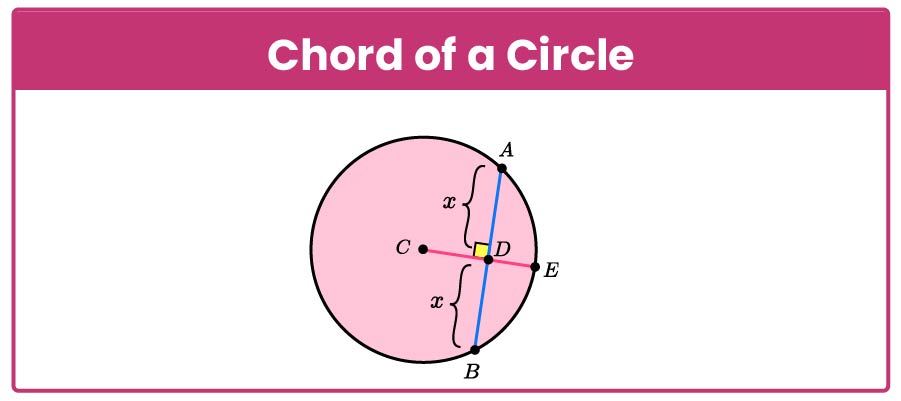
A cord of a circle in GCSE Maths circle theorems is a straight line segment which joins any two points on the circle's circumference. The longest possible chord is the diameter of the circle. A perpendicular drawn from the centre of the circle to the chord that divides the chords into two equal parts.
2. Demonstrating the Chord of a Circle Theorem
All you need to be confident with angles in a triangle and congruence.
3. How do You Apply it?
1. Locate the key parts of the circle for the suitable circle theorem.
2.Use other angle facts to determine any missing angles.
3.Use Pythagoras' Theorem or Trigonometry to find the missing length.
Example 1: cosine ratio
Q.Below is a circle with centre C. Points A, B, C, and D are on the circumference of the circle. The chord AB is perpendicular to the line CD at the point E. The line AE is 5cm and angle ADE=71°. Calculate the length of the line BC, correct to 11 decimal places.
Solution:
Step 1: Locate the key elements of the circle for an accurate circle theorem
Here we have:
CD is a diameter
AB is a chord perpendicular to CD
The angle ADE=71°
The angle BEC=90°
The line AE=5cm
The line BC=x
Step 2: Use other angle facts to determine other relevant angles.
As angles in the same segment are the same, angle ADE is equal to angle ABC, so angle ABC = 71°. As the perpendicular from the centre point of a circle to a chord bisects the chord, the line BE is equal to AE, so BE = 5cm.
Step 3: Apply Pythagoras' theorem or trigonometry
Now you know the side adjacent to the angle, and you are required to calculate the hypotenuse, so you need to use cos(θ)=A/H with H as the subject.
H= A/cos(θ)
x= 5/cos(71)
x=15.4cm(1dp)
2. Cyclic Quadrilateral
1. What is the Cyclic Quadrilateral Theorem?
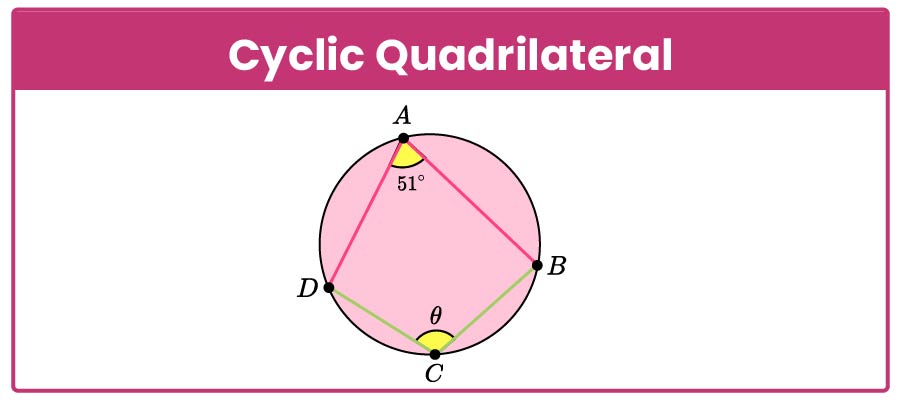
A cyclic quadrilateral segment in circle theorems refers to a four-sided figure whose corners all lie on the circumference of the circle. Along with its sides are forming chords. In such a shape, the sum of every pair of opposite side angles is always 180°.
2. Demonstrating the Cyclic Quadrilateral Theorem
To represent the opposite angles of a cyclic quadrilateral, a total of 180°, you have to make sure that the angle at the centre is twice the angle at the circumference.
3. How do You Apply it?
1. Identify a quadrilateral which has all four vertices lying on a circle.
2. Locate the pair of opposite angles in the shape
3. Apply the rule that opposite angles add up to 180°
4. Substitute the given angle value.
Example 1: Standard Diagram
Q.ABCD is a cyclic quadrilateral. Calculate the size of angle BCD:
Solution:
Step 1: Place the key parts of the circle
Here we have:
The angle BAD=51°
The angle BCD=θ
Step 2: Now you know that BAD = 51°, SO you do not need to use any other fact related to the angle to determine this angle for this example.
Step 3: As opposite angles of a cyclic quadrilateral total 180°, you can calculate the size of angle BCD.
BCD=180−51
BCD=129∘
3. Tangent of a Circle
1. What is the Tangent of a Circle theorem?
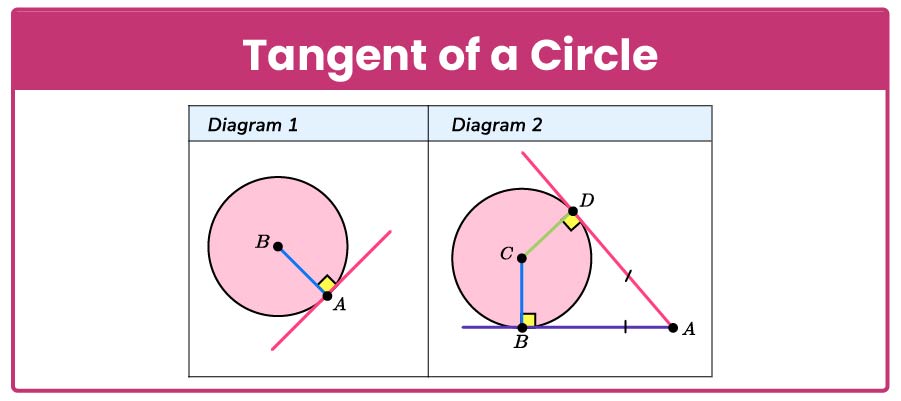
A tangent of a circle is a straight line which makes contact with the circle at one particular point.
Key points:
1. The angle formed between radius and tangent at the contact point is always 90°.
2. The length of the tangents that are drawn from the same external point to a circle is equal.
2. Demonstrating the Tangent of a Circle Theorem
From a point outside a circle, make two tangents to the circle. So by joining the points to the centre, two right-angle triangles will be formed. And these triangles are congruent, which shows that the length of both tangents is equal.
3. How do You Apply it?
1. Figure out the tangent and the point where it touches the circle.
2. Locate the radius to the contact point.
3. Apply the fact that the angle between the tangent and radius is 90°.
4. Apply relevant angle properties to get the missing value.
Example 1: angles in the same segment
Q. A, B, C and D are points on the circumference of a circle with centre O. AC and BD intersect at the point G. EF is a tangent at point C and is parallel to BD. Calculate the size of angle BCF.
Solution:
Step 1: Here we have:
The angle BDC=48°
ACAC is a diameter
EFEF is a tangent
The angle BCF=θ
Step 2: Angles in the same segment are equal, and so the angle is BDC = angle BAC = 48°. As AC is a diameter and the respective angles in a semicircle are 90°, the angle ABC is ABC=90°.
Step 3: Angles in a triangle are a total of 180°, thus you can calculate angle ACB.
ACB=180−(90+48)
ACB=42∘
Step 4: The angle is 90°between the tangent and radius, so you can calculate angle BCF.
BCF=90−42
BCF=48∘
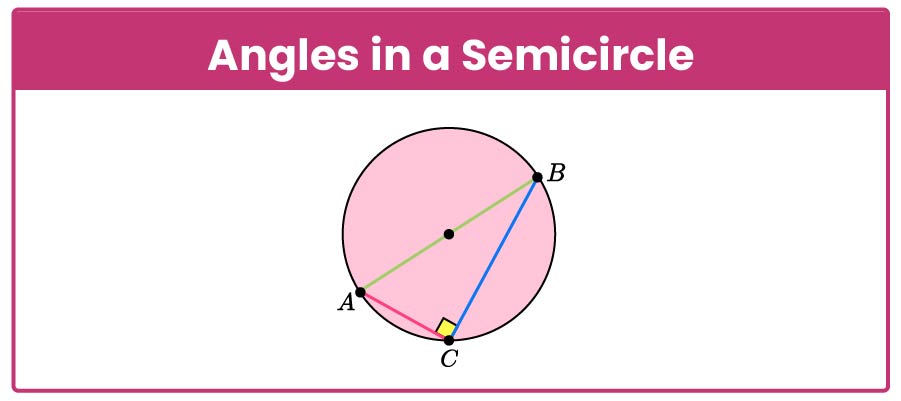
4. Angles in a Semicircle
1. What is the Angle in a Semicircle theorem?
The angle in a semicircle GCSE circle theorems refers to the fact that any angle formed at the circumference by a diameter must always be a right angle.
2. Demonstrating the Angles in a Semicircle Theorem
1. Draw a chord and two different points on the same arc.
2. Explains that both angles are subtended by the same chord.
3. Apply the properties of circle angles to justify equality.
4. Now, conclude that both are equal.
3. How do You Apply it?
1. Identify the two angles in the same segment
2. Confirm that these two stand on the same chord
3. Set the angles equal.
4. Solve for the unknown value.
Example
Some students may find it challenging to apply these rules correctly in problem-solving. In those cases, assignment help can provide step-by-step guidance with study material and solved examples to build a stronger understanding.
Example 1: angles in parallel lines
Q.AC and BD are diameters of the circle with centre O. BC and AD are parallel. Calculate the size of the angle OAB.
Solution:
Step 1: Here we have:
The angle COD=58°
BD and AC are diameters
OA, OB, OC and OD are radii
The angle BAC=θ
Step 2: AOD is an isosceles triangle as OA and OD are radii. It means that the other two angles are the same and:
OAD=(180−122)÷2
OAD=29°OAD=29°
OAB=90−29
OAB=61°OAB=61°
5. Alternate Segment Theorem
1. What is the Alternate Segment Theorem?
The alternate segment theorem refers to a rule in which the angle between a chord and tangent is equal to the angle made by the same chord in the opposite section of the circle.
2. Demonstrating the Alternate Segment Theorem
To prove the alternate segment circle theorem rules, it is crucial to know a few basic circle theorems and concepts. It includes the fact that the angle at the centre is twice the angle at the circumference, with the properties of tangents and chords in a circle.
3. How do You Apply It?
Identify the most relevant part of the circle required for the theorem.
Use known angle properties to find one of the angles.
Apply the alternate segment theorem to determine the missing angle.
Example
Now, let's understand the alternate segment theorem more precisely with a few solved examples. These will help show that the theorem is applied in different types of circle problems:
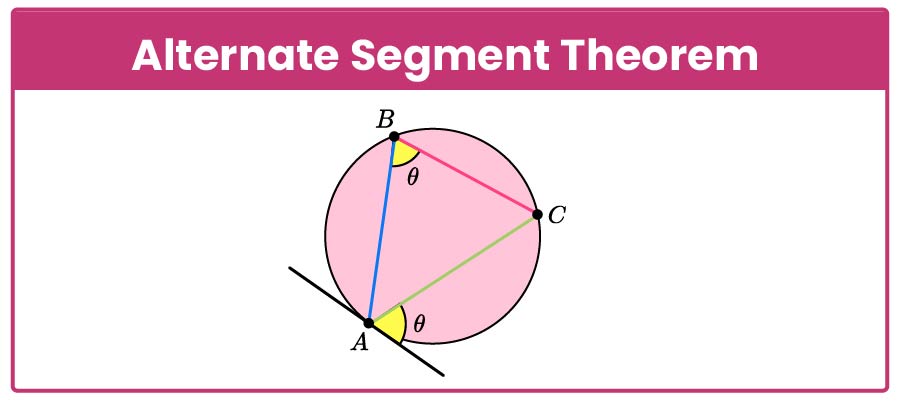
Example: Standard Diagram
Q. The triangle ABC is inscribed in a circle with centre O. The tangent DE meets the circle at the point A. Calculate the size of the angle ABC.
Solution:
Step 1. Locate the key elements of the circle for the theorem
Here we have:
The tangent DE
The chord AC (that meets the tangent)
The angle CAE = 56°
The angle ABC = θ
Step 2. Use different angle facts to determine one of the two angles
Now we already know that CAE = 56°, so we do not need to use any other angle fact to identify this angle for this example.
Step: 3. Use the alternate segment theorem to state the other missing angle
ABC = 56° as angles in the alternate segment are equivalent to the angle between the tangent and the associated chord
6. Angle at the Centre Theorem
1. What is the Angle at the Centre theorem?
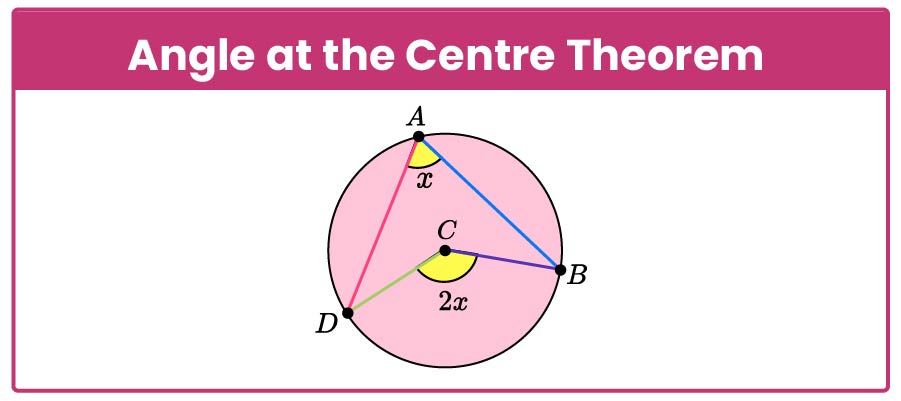
The angle formed at the centre of a circle is twice the angle made at the circumference when both angles are subtended by the same arc.
2. Demonstrating the Angle at the Centre Theorem
1. In a circle, the angle at the centre and the angle at the circumference stand on the same arc.
2. Using circle angle properties, the angle at the centre is always twice the angle at the edge.
3. Hence, ∠AOB = 2 × ∠ACB.
3. How do You Apply it?
1. Identify the standing angles on the same arc.
2. Apply the centre angle rule, which is 2* circumference angle
3. Substitute values to get the unknown angle
Example 1: angles in a triangle
Q.Below is a circle with centre C. Points A, B, and D are on the circumference of the circle. Calculate the size of angle θ.
Solutions:
Step 1: Here we have:
· AC == BC == CD == Radii
· AB is a chord
· AD is the diameter
· The angle ABC =46°
· The angle BCD =θ
Step 2: AC = BC, so you can say that ABC is an isosceles triangle, which means that the angle BAC = angle ABC = 46°
Step 3: The angle at the centre is twice the angle at the circumference, and so you need to multiply this number by 2 to get the angle BCD at the centre.
BCD = 4646 × 22
BCD=92°BCD=92°
7. Angles in the Same Segment Theorem
1. What is the Angles in the Same Segment Theorem?
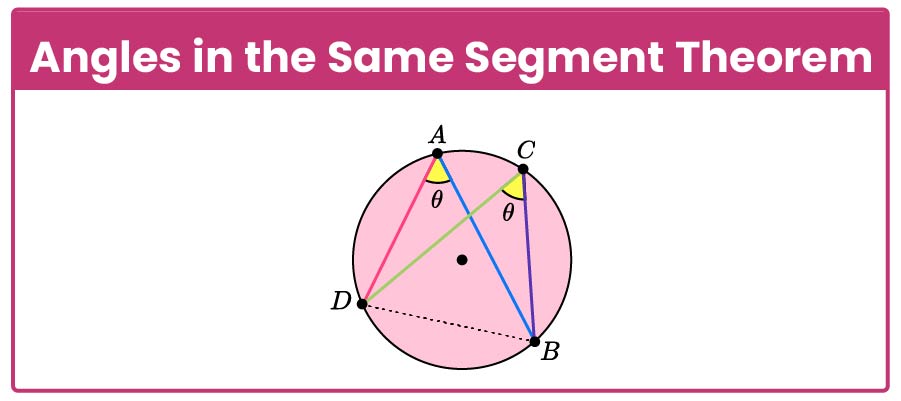
The Angles in the same segment theorem explains that angles formed by the same chord at different points on the circle are equal. These must lie on the same side of the chord. It helps in finding unknown angles in circle geometry without measurement.
2. Demonstrating the Angles in the Same Segment Theorem
For this, join the centre to the chord's endpoints. The angle at the centre is twice each angle at the circumference standing on the same chord. Since both angles share the same central angle, they are equal.
3. How do You Apply it?
1. Find the angles standing on the same chord in a circle.
2. As they are the same, set them equal and solve for the unknown angle.
Example 1: Angles in a Triangle
Q.The circle with centre O has four points on the circumference. The two chords AC and BD intersect at the point E. Calculate the size of angle ABE.
Solution:
Step 1: Here we have:
· The angle CDB=44°
· BD is a diameter
· AB, AC, and CD are chords
· The angle CED=79°
· The angle ABE=θ
Step 2: Vertically opposite angles are equal, and so the angle BEA is 70°. Angle CDB is in the same segment as the CAB angle, and thus both are equal. It means you can calculate the respective size of angle ABE as the angles in a triangle total 180°.
ABE=180−(79+44)
ABE=57°
To learn more about these theorems, check out Maths assignment help online. They offer detailed notes with examples that can help clear any doubts. Moving on, let's understand how to use or apply these circle theorem exam questions in the answers.
List of Important Circle Theorems GCSE questions
Here are the circle theorems GCSE questions for practice before the exam for improvement:
1. In a circle, AB is the diameter, and C is a point on the circumference. Find ∠ACB. (90°)
2. The angle at the centre of a circle is 100°. What is the angle at the circumference subtended by the same arc? (50°)
3. In a circle, two angles in the same segment are formed by the same chord. If one angle is 45°, find the other. (45°)
4. A cyclic quadrilateral has one angle measuring 110°. Find the opposite angle. (70°)
5. A tangent touches a circle at point A. The radius OA is drawn. What is the angle between OA and the tangent? (90°)
6. From a point outside a circle, two tangents are drawn. If one tangent is 8 cm, find the length of the other. (8 cm)
7. In a circle, a chord AB subtends an angle of 70° at the circumference. What is the angle at the centre? (140°)
8. In a cyclic quadrilateral, one angle is 85°, and its adjacent angle is 95°. Verify if the shape is cyclic. (Yes)
9. A tangent and a chord form an angle of 40° at the point of contact. Find the angle in the alternate segment. (40°)
10. In a circle, two tangents meet at a point outside the circle, forming an angle of 60°. Find the angle between the radii to the points of contact. (120°)
Mastering these concepts helps you solve geometry problems with confidence, and a strong understanding of all circle theorems GCSE is essential for success in exams.
Get Help from Experts for Your Math Assignments
Are you struggling to solve the circle theorem assignment? Is it difficult for you to solve complex math problems? The perfect solution is to get assistance from our experts online. They share a step-by-step guide to approach the questions systematically. Further, they offer specialised help and cater to different requirements of the questions. One can simply ask the experts to do my homework and get the best answers to the complex problems in no time. Math assignments require one to know the basics, and with the help of our experts, one can learn and solve questions simultaneously. Check out our expert services for the best quality answers.
Read More: 100+ AP Research Topics Around Different Fields
Was This Blog Helpful?


Most Popular Questions Searched By Students
- What is the Easiest Circle Theorem?
The easiest circle theorem is "angle in a semicircle", which always forms 90 degrees using the diameter and circumference points. - Why is the Angle In a Semicircle 90 Degrees?
It is 90 degrees absolutely, because a diameter subtends a semicircle, making the angle at the circumference points.
- Are circle Theorems Important in the GCSE Exam?
For solving geometry problems and scoring marks in structured questions, circle theorems are very important. - How to Remember All Circle Theorems?
You can remember by: - 1.Practicing diagrams
- 2.Understanding logic
- 3.Using short rules linked with visual circle relationships.



Get 5% Cashback
On App - Grab it while it lasts!

Download app now (or) Scan the QR code



Login / Sign up
Get Your Free Dissertation Outline NOW !Congratulations!
Check Your Registered Mail for download

- Plagiarism
- Pricing
- Order Now
- Call Back