

- Take a look at the bigger picture. Make sure your choices are consistent and justified, not random.
- Clarify your research philosophy, and if needed, use the research philosophy section to compare.
- Decide your research approach. The SRO helps you distinguish between deductive, inductive and abductive approaches.
- Choose a methodological choice as SRO explains quantitative, qualitative, mixed methods and multi-method. You can select your research strategy as SRO helps match strategies to your method, like survey, case study, experiment, interviews, etc.
Know Different Layers of Saunders Research Onion With Examples
18 Apr 2025
7428 Views
Share


Table of Content
The most difficult part about an academic paper is not writing but research and choosing the topics and methodologies. These make your content reliable and support your arguments. To make this process easier, Saunders et al Research Onion (2007) was developed. Designing a research methodology can feel overwhelming, with so many philosophies, strategies, and method it's hard to know where to begin. The research method provides a structured framework that guides you through tough choices. But what exactly is Saunders Research Onion? If you have this question, then read this blog, which will cover the research method without issue.
What is Saunders Research Onion?
Saunders research onion is a framework to design research methodology developed by Saunders, Lewis, and Thornhill. The framework helps researchers make clear, logical, and justified methodological decisions by organising them into layers, just like an onion. It depicts what decisions to make in what order when you plan a research study. The purpose of SRO is to help researchers structure their methodology, ensure consistency between research decisions, and clearly justify their chosen methods. In brief, it is a step-by-step guide to build a strong and well-organised research methodology. The method illustrates the nature of research design, and the layer shows the complexity you will face while conducting a study.
Different Layers of Saunders' Research Onion Explained With Examples
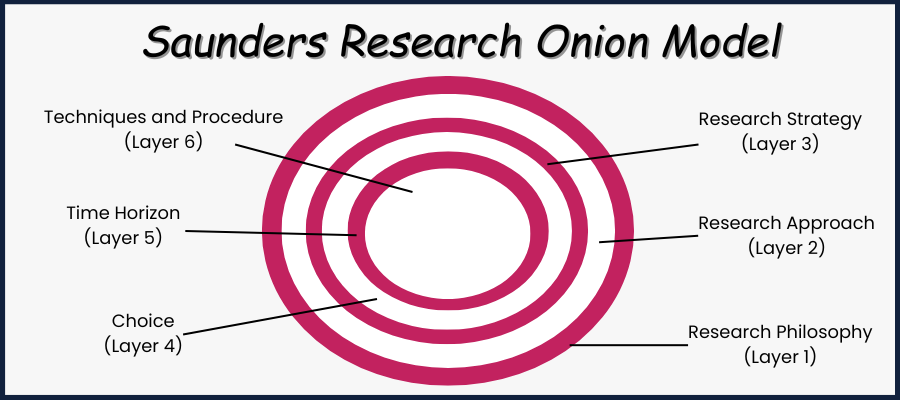
As in the previous section, you learnt what Saunders research onion model is; now is the time to learn about the different layers of it. To understand those layers, firstly, wear glasses; peeling might cause irritation in your eyes. Apart from the joke, to understand all these layers of onion, you need to properly peel each layer and understand it, as if you missed anything, it might create a problem for you in understanding the other layers. Moving ahead, the research onion Saunders framework contains six layers.
- Research Philosophy
- Research Approach
- Research Strategy
- Choice
- Time Horizon
- Techniques And Procedures
These were the six layers of the research onion methodology. Go and start peeling them, and do not forget to understand each one of them properly. Some understand via reading, while some need diagrams to understand. Here is a Saunders research onion diagram for the visual learners.
Research Philosophy
You will find research philosophy when you peel the first layer of the research onion. Well, the question arises: what is a research philosophy? It is the foundation of any study, because it describes the set of beliefs upon which the research is built. This form of a layer can be described from the point of view of either an ontological or epistemological. The ontology means the "what" and "how" of what you want to know. On the other hand, epistemology is about "how" we can obtain knowledge and understand things easily. After understanding all those things, let's understand the three main research philosophies that operate from these two.
Example:
The layer research philosophy addresses the beliefs about the nature of knowledge and reality. The example will guide you on how to approach the data and assess the findings.
Chosen Philosophy: Positivism
Reasoning: The researcher has a belief that consumer behaviour can be objectively measured and that patterns in the actions of the consumer and states it can be generalised to larger populations. Positivism supports using quantitative methods and analysing consumer data using stat technique.
How it supports the research: The researcher would likely use surveys that can help collect quantitative data, assuming that there's an objective truth that can be measured about how social media influences buying behaviour.
Next,
Chosen Philosophy: Interpretivism
Reasoning: The researcher wants to understand the subjective experience of consumers and how social media marketing is perceived or interpreted in different contexts. Interpretivism focuses on meanings, feelings, and personal experiences.
How it supports the research: The researcher might conduct qualitative interviews or focus groups to understand the deeper, personal point of view and motivations of consumers, rather than just relying on raw stat answers.
- Positivism
- Interpretivism
- Pragmatism
These are the most common and provide a good starting point for understanding the philosophies.
Positivism
This type of research provides knowledge outside of the topic you are studying. This study includes only the objectives, and you can put your personal opinion or point of view in it. Positivism research gives a view about knowledge that can only be acquired through empirical research; that research is based on measurement and observation. In positivism, the information can only be accurate, fake, or senseless. If something is not authentic or fake, it doesn't hold any ground, and that is dismissed.
Interpretivism
After positivism, interpretivism focuses on the influence of the social and cultural environment on an individual. The interpretivism of Saunders Onion's research majorly focuses on people's thoughts and ideas. In this research, the student plays an active role in the study, as it is necessary for drawing a holistic view of the participants and including their thoughts, actions, and meanings.
Pragmatism
This part of the research philosophy highlights the importance of using the best tools possible for the investigation. The primary role of this is to research the basis of practical points of view, where you don't know what you will get. The knowledge is not fixed, but instead, the information is constantly questioned. Pragmatism is an element of research that subjectively specifies when the drawing conclusion is based on participant response and decision.
To recap what you learn in this, the research philosophy of Saunders' onion research plays the foundational role in any kind of research and reflects the epistemological and ontological assumptions made by a researcher. While making the methodology for your research or dissertation, the first thing you need to do is to think about the philosophy which you are going to use.
Research Approach
After the first layer, let's peel another layer of the research onion Saunders framework, and understand it. The research approach is the most important and broader method which you need to use in your research to get results. It's really crucial for you to clearly identify your research method, as it will inform the decision you take in terms of data collection and analysis in your study.
Example:
Approach chosen: Deductive Approach
Reasoning: The researcher starts with a hypothesis or theory based on old literature. For instance, “Social media marketing is positively impacting buying behaviour.” The researcher would then collect data to test the hypothesis.
How It Shapes the Research: The researcher would create a survey to collect data that could either confirm or reject this hypothesis. The study would use statistical methods to test the hypothesis.
Next,
Chosen approach: Inductive Approach
Reasoning: The researcher will not start with a pre-defined hypothesis but instead looks to identify patterns or themes from data. This approach is often used when little theory exists about the specific topic.
How it Shapes the research: The researchers may conduct in-depth interviews or focus groups to explore consumer experiences and perceptions of social media markets. Based on the data collected, the researcher would develop theories or insights about consumer behaviour.
Indicative
It is an approach that entails generating different theories from research, instead of starting a project with a theory as a foundation. It can be used for a study on unknown isolated people, as there is very little information about them. Therefore, this can help to gain information about them. Learn about the inductive research approach through examples:
Educational Research:
- Observe: A teacher noticed that students in their class are able to learn better through group discussions than when they are asked to complete assignments.
- Process: The teacher collects data about students' performance across distinct groups vs individual assignments.l
- Theory Development: After they observed the patterns, they theorised that collaborative learning improves learning methods improve student engagement and learning outcomes.
Market Research:
-
Observe: A company notices an increase in sales when it advertises on social media apps, especially among younger consumers.l
-
Process: The marketing team then starts to collect data from these social media platforms and tracks the ads that lead to higher engagement and sales.
-
Theory Development: They can conclude that young buyers are more influenced by social media ads, which leads to higher engagement and sales.
Deductive
This approach begins with a theory and aims to build the research further. It would be investigated when studying the changes in the physical properties in animals over the period of time, because it would likely be rooted in the theory of evolution. Read and learn more about the deductive research approach through examples:
Educational Research:
- Hypotheses: Students who receive feedback daily on their assignments will have a better academic performance.
- Process: Researchers design a study where one group of students receive daily feedback and another one does not.
- Testing: The researchers compare the academic performance of both groups after set period.
- Conclusion: If the experimental group performs better, the hypothesis is correct; if not, it is rejected.
Market Research:
- Hypothesis: Customers who see advertisements featuring celebrities are more likely to pay more and buy the product than customers who see ads with non-celebrity models.
- Process: To test, the company runs two different ad campaigns: one with a celebrity spokesperson and one with a regular model.
- Testing: Sales data and customer responses are collected to compare the impact of two ad campaigns.
- Conclusion: If the celebrity-ad campaign leads to higher sales, the hypothesis is supported. If not, the hypothesis will be rejected.
This section answers the question about what's the importance of qualitative and quantitative data to research approaches. Understand that the inductive approach is usually used within a qualitative type of research, while quantitative research tends to rely on the deductive approach. Quantitative research starts with theory as a foundation, and progress is made through hypothesis testing, which is the reason to use a deductive approach.
Research Strategy
So far in this blog, you have learn about the conceptual and intangible aspects of the research onion Saunders. Now, it's time for you to peel another layer of this onion. Let's talk about the practical way of research. The research strategy is the layer of the onion that gives details on how, for the aims of the study, the study can be conducted. The strategy includes several strategies that you can use to get results. Look at them and understand them, as they will help you in future studies.
Examples:
Strategy Chosen: Case Study
Reasoning: The researcher wants to study the impact of social media marketing on a specific company or group of companies in detail.
How it shapes the research: The researcher collects qualitative data through interviews with marketing managers, analyses the company's social media campaigns, and looks at sales data before and after campaigns to understand the impact on consumer behaviour.
Next,
Strategy chosen: Survey
Reasoning: The researcher chooses a survey to collect quantitative data from a large number of consumers to get general patterns or trends of people's buying behaviour influenced by social media ads.
How it shapes the research: The researcher develops a questionnaire with Likert scale questions, collects responses from many participants, and analyses the data statistically to find correlations between social media use and decisions related to buying.
- Experimental research
- Action research
- Case study research
- Grounded theory
- Archival research
Experimental Research
This layer of the onion uses the manipulation of one variable to observe the changes in another variable. It is used to assess the relationship between the two variables. The primary purpose of this is to support, refute or validate the research hypothesis. This type of strategy follows the principles of the scientific method and is done in a controlled environment. In the experimental research, you need to research the existing theory rather than making a new one. It is also allied with the positivist study, as it also thinks that informatics can only be studied objectively and in an isolated form. However, if you face any problem with a research paper, you can seek research paper help from experts.
Action research
Now, let's get to the next part of this peeling process. Action research involves learning by waiting for the action of the variable. This kind of research is conducted in a practical setting like a classroom, hospital or workspace. They help you to find problems or weaknesses related to the interaction within the real world. Participants are given a lot of attention with the aid of action research. These kinds of research onion models are applied in the social sciences, specifically in the professions where individuals aim to improve themselves and the work that they are doing.
Case study research
The case study is an in-depth research on a single subject. For example, a person, a group, an institution, an event or any issue. This is a type of process in which one does an in-depth study to gain a proper understanding of the issue in a real-life setting. The main thing here is to gain depth of knowledge within the context of the study. In the case of taking the social context and culture into account, which means that this research falls under the qualitative and tends to be inductive. Also, since the researcher's assumptions and understanding play a role in a case study, it is typically informed by an interpretative philosophy.
Grounded theory
This theory is all about 'letting your study or the data speak for itself'. In this, you need the data to inform the development of any new theory, model or framework. The theory which is developed is grounded in the data. This research onion model is beneficial for research into issues that are entirely new or under-researched. The grounded theory is qualitative and takes an inductive approach.
Archival research
This may be last but not least, the archival research strategy draws from the materials that exist, and is established by using the review of this existing data. This data type is suited for historical research and can be used in materials such as manuscripts and records.
As of now, you have seen a wide range of research strategies, but it depends on you which one you will choose, and it also depends on your aim and objectives. Also, it depends on the choices you make in terms of research philosophy and approach.
Choice
Now, let's talk about the next peel of the research onion Saunders. The next layer of the research is simply called choices; it could have been more specific. In any case, this layer is simply about deciding how many data types, like qualitative or quantitative data, you will use in your research. There are three choices: momo, mixed, and multi-method. Let's get to know more about these methods further.
Example:
Methodology chosen: Quantitative
Reasoning: The researcher wants to gather numerical data that can be analysed statistically to test hypotheses about consumer behaviour.
How it shapes the research: The researcher may use surveys or other experiments, collect data such as the frequency of social media usage, the amount of time spent on ads, and how these factors relate to purchase behaviour. The data would be checked using stats software like SPSS or Excel.
Next,
Methodology chosen: Qualitative
Reasoning: The researcher is more interested in exploring consumers' experiences and attitudes toward social media ads, rather than trying to measure numerical data to get answers.
How it shapes the research: The researcher may use in-depth interviews or focus groups to gather detailed personal insights about how consumers view social media ads, how these ads influence their decisions, and what factors affect their purchase-related behaviour. The data would be analysed for emerging themes or patterns.
Mono Method
When you choose this method, it means that you will only make use of one data type, either qualitative or quantitative. For instance, if you conduct research on a community's opinion on a specific pizza restaurant, you can use the qualitative approach only to analyse the participants and their opinions about the restaurant.
Mixed Method
It is a blend of both quantitative and qualitative methods. Taking the example of the previous one, if you want to know which community of people eats a specific type of pizza, you need to conduct a survey and get the results of that survey to collect quantitative data and then to know the statistics in a form, developing quantitative outcomes in addition to your qualitative ones. If you're still confused about what choice you need to make for your work and, in frustration, you surfed, "Can you do my assignment for me?" Well, yes, our experts will provide you with the best assignment and the best choice of research, which will suit your topic and work.
Multi-Method
Last but not least, in this type of research, you will like to use a wide range of approaches, with more than just one quantitative and one qualitative approach.
Time Horizon
Let's talk about the fifth peel of the Reach onion, Saunders: the time horizon. To simply describe it, it helps you to express the many points in the time you plan to collect the data. This peel also has two options. The cross-sectional and longitudinal time horizons.
Examples:
Time horizon chosen: Cross-sectional
Reasoning: The researcher wants to collect data at a single point in time to know the current impact of the social media market on buyer behaviour.
How it supports the research: The researcher may provide and send out a survey to a sample of consumers, asking them about their social media habits and recent buying behaviour. The data would be analysed at that specific point, giving a snapshot of the impact at that moment.
Next,
Time horizon chosen: Longitudinal
Reasoning: The researcher wants to understand how the impact of social media marketing advances over time, for example, they try to examine the effectiveness of campaigns over several months or years.
How it supports the research: The researcher would collect data from the same group of consumers over an extended period, perhaps sending them surveys at different intervals, tracking changes in their purchasing behaviour after multiple marketing campaigns.
Cross sectional
This process is used to examine the different groups of people at a single point; it is used to offer a snapshot of a population's characteristics or their behaviour at that moment.
Longitudinal studies
The longitudinal studies track the same individual over time, allowing researchers to observe the changes and the trend in the behaviour or the characteristics of that individual.
Techniques and Procedures
So that is the end; you have reached the end peel of this onion research model. This is where you come to the real practicalities of your research,h where you make choices regarding specific techniques and procedures.
Examples:
Chosen technique & Procedure: Questionnaire (Survey)
Reason: The researcher wants to collect data efficiently from a large number of respondents efficiently and gain measurable, quantitative data related to consumer attitudes and behaviour.
How it supports the research: The researcher can design a structured questionnaire with close-ended questions (like Likert scales) and distribute it online to consumers. The collected data can be analysed to identify patterns, relationships, or trends equal to research objectives.
Next,
Chosen technique & Procedure: Semi-structured Interviews
Reason: The researcher wants in-depth insights into participants' opinions, experiences, and perceptions that cannot be fully understood by numerical data.
How it supports the research: The researcher would conduct interviews using a set of guided questions while allowing flexibility for follow-up questions. It enables participants to explain their views in detail, which helps the researcher better understand the underlying reasons behind behaviours and decisions.
In this, you need to decide what you will collect and what data collection methods you will use.
- Decide how you will go about sampling the population.
- Determine the type of data analysis you will use to answer your research question.
- Set up the materials you will be using for your study.
It is crucial to note that these techniques and procedures need to go hand in hand with all the other layers of this procedure: research philosophy, research approach, research strategy, choices, and time horizon.
This section covered techniques and processes that you can use, and this was the last part of the onion model. As you peel the last part of the onion, these will all help you do research in a better way, and after you understand the research method, you can use these methods efficiently. Well, there might be a question in your mind about which discipline you are going to use it for. Therefore, next up, you will learn to use them in different disciplines.
Use of the Research Onion in Various Disciplines
The onion research framework can be used in different disciplines and industries, showcasing its versatility and effectiveness in guiding. If you want to know where you can use this onion, rather than in food, then read the lower section and understand how it has been used in different fields.
Business and Management Studies
In the world of business and management, the research onion plays an important role, as it is used for understanding consumer behaviour, market trends and organisational dynamics.
Social Sciences
The research onion model is valuable in fields like sociology, psychology and anthropology. In the field of sociology, it can be used to investigate social inequalities, while in psychology, it may be employed to study cognitive processes.
Healthcare and Medicine
In medicine and health care, the research onion is used to guide clinical and epidemiological research. Whether studying new medical treatments, assessing the public, or anything else, research only really relies on the research onion model.
Market Research
The main work of the onion research in this field is to understand the consumer behaviour, preference and trend. The researcher gathers valuable data in order to report product development and marketing techniques, including brand positioning by employing techniques like surveys and observation.
Limitations of Saunders' Research Onion
So now you know the use of the Saunders research onion method. As of now, you know six essential things, and I hope you have read the above section to understand all of them and peel all the layers one by one. Also, you get to know about the use of this method in different fields and how it helps researchers in those fields. Now, let us discuss some of the drawbacks which people face.
- The first drawback of this method is that it can be too simplistic and may not fully capture the complexities of research methodology.
- This model only assumes a linear and sequential approach to research, which may not always reflect how research is conducted in practice.
- Some other critics. A review of this model exists; some say this model may be too prescriptive and does not allow for the unique circumstances of individual research projects. The model may also prioritise certain aspects of the research over others, and there may be a lack of clarity around the boundaries.
Final Thoughts
So in this blog, you learnt about the research onion model by Saunders. Hopefully, you understood all the layers correctly that you will use and help you in the future. Also, if you are part of a field like business, marketing, or any other, this method will help you do research and find results more effectively. Just like a double-edged sword, there are also many drawbacks to this model that you may face. You need to understand this model correctly. If you are still having problems using this method or any other problem with your assignment, you can get assistance from an assignment writing service. The service will provide you with a good-quality assignment, with all proofreading done. It will help you score well in your academic journey.
Read More: 175+ Trending ABM Research Topics For Students
Was This Blog Helpful?
Frequently Asked Questions
- How to use Saunders' Research Onion to Clarify your Research Methodology?
To clarify your research methodology using Sanders’ Research Onion, you have to: - What are the benefits of Saunders Research Onion?
The research onion provides structure via a roadmap for your methodology. It helps you justify at every stage of your research writing and keeps the content consistent throughout.
- What is the Purpose of Saunders Research on Onions?
It is a simple tool that has the purpose of guiding your methodology choices, from big ideas to practical steps. - What is the onion peeling theory?
The onion peeling theory is a metaphor to design your research methodology step by step, like peeling onion. Each “layer” represents different decisions that you need to make about your approach.





Get 5% Cashback
On App - Grab it while it lasts!

Download app now (or) Scan the QR code



Login / Sign up
Get Your Free Dissertation Outline NOW !Congratulations!
Check Your Registered Mail for download

- Plagiarism
- Pricing
- Order Now
- Call Back