What is era cycle? A Simple Guide with Examples


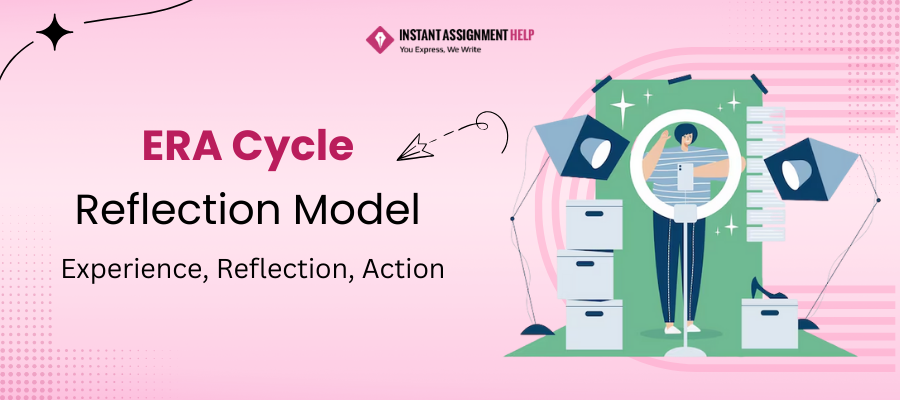
Table of Content
The Era Cycle is a simple approach of reflection, developed by Jasper (2013). It is built on three stages and is widely used in academic reflection, and it helps build character in students.
Together, these 3 crucial stages can guide anyone to the Path of reflection.
Experience (What happened?)
Reflection (So what did you learn?)
Action (How can you improve?)
Furthermore, this framework is easy to remember and follow. The key reason for its wide use is because of its;
- Simplicity
- Clarity
- Support new ideas
What Is the ERA Reflective Framework
The ERA Reflective practice framework gives reflection a personal meaning. The ERA model can guide learners to reflect in simple steps rather than feeling burdened by it.
The three stages of the ERA cycle of reflection
|
Experience |
Reflection: |
Action |
|
What happened |
What went well |
What can they do differently? |
|
Where |
What didn't go well |
Design a plan |
|
When |
Why didn't it go well |
How to avoid similar situation |
|
Who was involved |
What did you feel |
Plan of action |
This is our plan of action to avoid negative outcomes: For positive outcomes, students should ask for. Moreover, students look for Assignment help tools for guidance with their academic projects.
Experience: Describe What Happened
This is the first phase of Jasper's ERA model of reflection. It focuses on giving facts and details of any event. At this point, this stage sets the students to explain what happened, without any judgment of their own. Moreover, it helps the reader to know the context for reflection.
When an experience can be described by
- The Specific State: what happened, where it happened and when it took place.
- The Participants State: To find who was there and what their role was
- The context: Explain the background. Was this a regular occurrence or happened "out of the blue"
- The Event: Outline the action you and others took. right then and there.
- The outcome: Explain what the "summary" of the whole situation was.
Reflect: Making Sense of the Experience
In the reflection stage, the focus shifts from "what happened" to " why it happened" and "how it impacted you". This phase is about making sense of the whole experience, which usually happens through our emotions. The more emotionally heavy a situation is, the more learners tend to remember it for a long period of time.
For reflection, students should consider;
- Emotional Response
- Impact: An important part of the whole experience, and why?
- Evaluate: What went well and what was difficult.
- Internal Drivers: How can personal views or values have an impact on the reaction to the situation
- Theoretical Links: Can this experience connect to any subject or past lesson that students have learned
Action: Plans for Improvement
The final stage can help learners convert insights from the experience into action for future improvement. This helps students to understand their performance and how they can handle the same situation effectively the next time. Moreover, this connects reflection to progress. Without action, there is no point in reflection, and it becomes redundant.
To create effective plans, students should know;
- The learning outcome
- Change in Behaviour
- Skill gap
- Support system
- Time line
- Goal
To develop effective improvement strategies, students sometimes seek nursing assignment help for guidance in structuring actionable outcomes.
Why the ERA Model of Reflection Is Widely Used
The Era model of reflection is widely used because it gives a starting point for reflective skills in a step-by-step process. Unlike the other complex frameworks that exist. Instead, it gives structure to thinking by natural progression. Teachers prefer it the most because it can be used quickly and can work across different academic subjects and levels of study. Whether used in long reports or short essays or for psychology assignment help.
The key reason for its widespread use is its simple reflective model
- Beginner Friendly
- Structure clarity
- Efficiency
- Connect theory to practice.
Easy for Students to Understand
One key reason for its popularity is clarity. The ERA reflective model is tailored for students and new learners because it breaks complex problems into a simple structure.
Why do students find it easy?
- Bare Bone structure; Experience, reflection and action
- Gut feeling: The structure shows human tendency and natural learning process. For example, when we go out in the rain (experience), to get wet (reflection), and finally, what if an umbrella would be beneficial from next time (action), and learning for the future
- Constant loop for improvement; Give structure to get clarity without feeling overwhelmed
- Relatability: Can be applied to any situation, positive or negative, making it effective for personal and academic learning
Detect Plagiarism in Your Assignment in Seconds!
Avail timely results with unlimited number of revisions



Encourages Active Learning
The ERA cycle of reflection promotes active learning; it isn't only about reflecting back on the past but about moving forward by taking action. Additionally, it supports independent learning instead of surface-level engagement.
How it drives engagement
- Closes the learning loop
- Encourage responsibility
- Promote trial and error for learning
- Find the practical learning gaps
The shift in focus from past reflection to action for a better future
Useful Across Academic Disciplines
The ERA framework's greatest strength is its universal use and logic. The ERA reflective cycle is used in
- Education
- Business
- Healthcare
- Psychology
- Education
- Social work
- Creative Arts
ERA works on the basis of?
- What is your “Experience?”
- What do you “Think?”
- What will you “change?”
This can help connect theory to the real implications of the subject
Foundation for Deeper Models
The ERA practice framework is the gateway for critical thinking. Students have to learn three core stages to build cognitive thinking.
ERA provides a base for more complex models in multiple ways
- Scaffolding: It shows the difference between objective description and subjective analysis.
- Logical flow: It mirrors the "What? "So what? Now what?" structure of Driscoll's model of reflection
- Find Themes: As students repeat the ERA cycle, they start to notice patterns and move from events to general principles, thus helping students move from "abstract ideas" to stage Kolb's experiential learning cycle.
ERA Cycle Compared to Traditional Reflection
Student tend to struggle with grammar and can look for tools like Free Grammar Checker UK.
|
Features |
ERA Model |
||
|
Stage |
Experience, Reflection, Action |
Description, Feelings, Evaluation, Analysis, Conclusion, Action Plan |
Concrete Experience, Reflective Observation, Abstract Conceptualization, Active Experimentation |
|
Best Used |
Beginners & quick reviews |
Deep emotional & critical analysis |
Theoretical learning & experimentation |
|
Key Focus |
Immediate improvement |
Making sense of feelings |
Create new theories |
Using The ERA Cycle in Academic
In academics, the ERA cycle is used to make students understand theory better, with implications for practical use. It helps students to move beyond academic learning. Furthermore, the Driscoll's “What? So what? Now what?” model can be used
- The "Experience" ('The What')
In academic writing, keep this section concise. Roughly 10-15% of the total word count
Focus: State the exact case study, such as a lab experiment or interviews for placement
Link: Use this to use real-world examples
- The "Reflection" (The 'So What')
This is the "bare bones" of your academic work. Roughly 50 to 60%)
Critical analysis: Don't just share your feelings; try to connect them to academic literature. For example, "If you are reading Crime and Punishment and writing a journal entry from the character's perspective. This works hand in hand with Kolb's experiential learning cycle
Evidence: Reference the particular chapters and explain why the event happened the way it did in a novel
- The "Action" (The 'Now What')
Teachers look for SMART goals (25 to 30%)
Specify: Rather than just reading the novel. Instead, look for creative action like
- Share and discuss the journal with peers for self-reflection
- Develop an understanding of philosophical themes and character
- Write an essay using this theme.
Key Takeaways
- The structure: This is a three-stage cycle. Experience "Facts", Reflection "Understanding thoughts and feelings"
Action: "Plan on how to improve"
- The Beginning: Designed by Melanie Jasper. This is the start of the Reflective Thinking stages"
Why it works: It works on logic and a clear structure, making it critical for education.
- The Academic Edge: For students, it gives a clear connection between theory and practical application
The Bottom Line: The era cycle can turn every experience into a character development opportunity by never stopping at " What happened" and pushing for "What's next."
Read more: Most Common Grammar Mistakes and How to Fix Them
Was This Blog Helpful?


Most Popular Questions Searched By Students
- What is the ERA cycle used for?
It is a framework for self improvement, reflective learning. and personal growth. Through Experience, Reflection and Action. - Is the ERA model suitable for all subjects?
Yes, it can be applied across different disciplines, including education, business, nursing and psychology.
- How is the ERA model different from other reflective models?
It is beginner friendly and focuses on three stages, making it easier to apply in different context. - Can beginners use the ERA reflective cycle?
Yes absolutely, its simple structure and framework make it ideal for students who are new to the process of reflective writing.


Get 5% Cashback
On App - Grab it while it lasts!
Download app now (or) Scan the QR code



Login / Sign up
Get Your Free Dissertation Outline NOW !Congratulations!
Check Your Registered Mail for download

- Plagiarism
- Pricing
- Order Now
- Call Back